What Is and What Is Not Traceability? The Most Common Myths
Growing quality requirements, increasingly stringent legal regulations, and customer expectations regarding production transparency mean that traceability is becoming one of the pillars of modern production management. Despite this, many misconceptions still surround it. Companies often invest in it while only partially implementing the idea of product traceability.
Production Under Scrutiny: What Traceability Tells Us
What exactly is traceability, and what can it offer to manufacturing companies? What areas of the process does it cover, and what are its types? Is it merely a regulatory requirement – or a practical tool supporting production efficiency and safety?
From Paper Documentation to Full Traceability. The Digital Transformation at OnlyBio.life
Millions of items annually, hundreds of formulas, continuous product launches, adherence to strict quality standards and GMP requirements, multiple legal obligations – this is the reality of many FMCG companies. In such an environment, traceability is no longer a nice-to-have addition, but a necessity. Moreover, its dependable performance is the condition for a business’s stable growth.
Digital Technologies and Strategies for Increasing Energy Efficiency
We live in an era of spectacular changes — Technological, Economic, and Business-related. Changes we can prepare for, and those that surprise us day by day.
Boost Productivity with AI. ImFactory and Braincube
Your manufacturing data may hold far greater potential than you think. Find out how to unlock it and genuinely boost efficiency — without costly investments in new infrastructure.
Transparency, control over production processes, and comprehensive knowledge of what happens to a given product at every stage – all of this is made possible by traceability systems. Is it worth implementing them in your company? In which industries does effective product tracking have particular significance? How does a dedicated traceability system differ from an ERP?
Customers are increasingly interested in the origin of the products they purchase. Quality and safety are of paramount importance. This is particularly significant in certain industries such as food, pharmaceutical, aerospace, and automotive, where manufacturing companies must meet a range of requirements to ensure their products comply with stringent regulations. A traceability system that allows tracking the flow of products can prove to be of great help in maintaining proper standards.
Such systems not only contribute to improving quality and safety but also help demonstrate the transparency and authenticity of products, which builds consumer trust.
What is traceability?
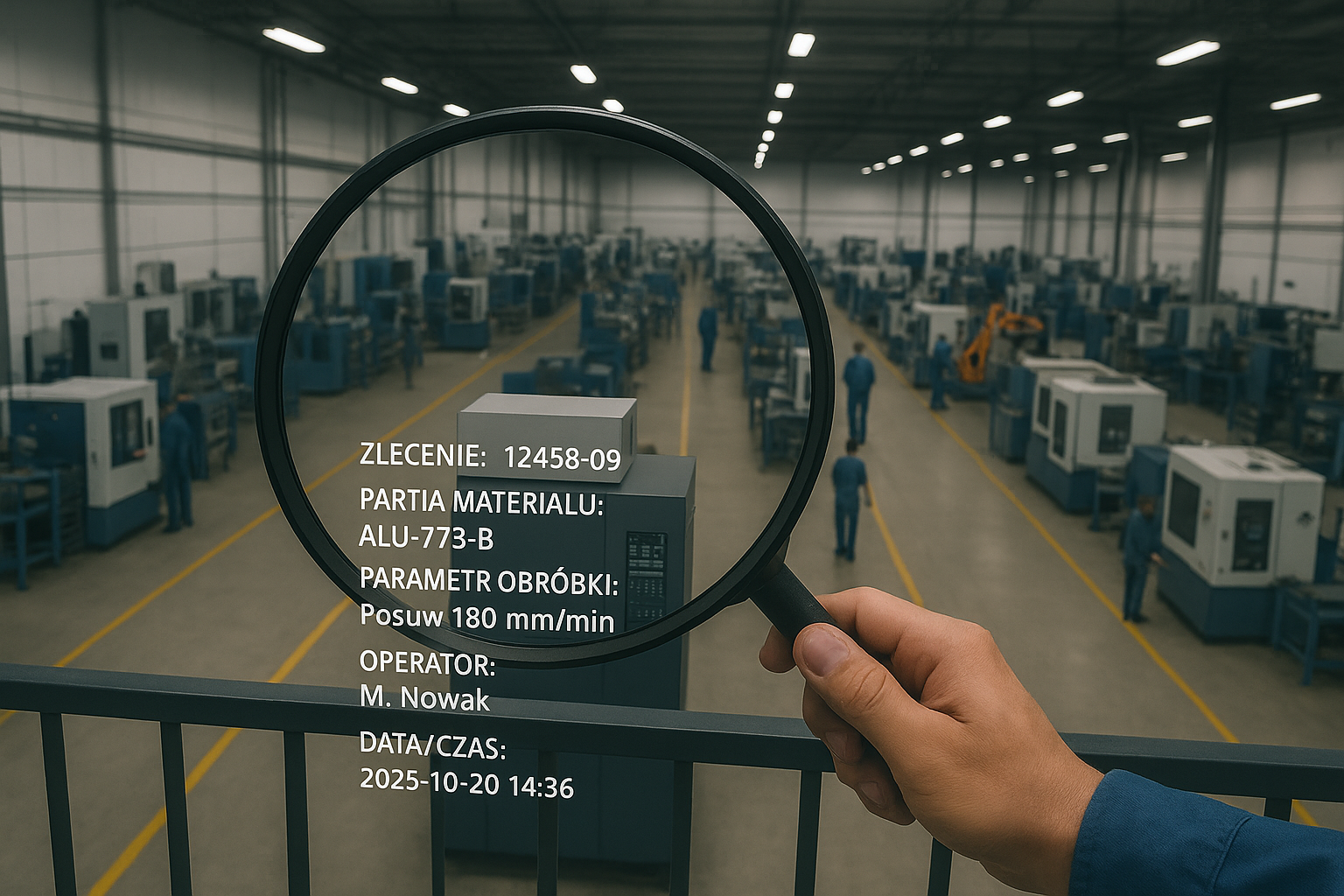
Traceability is the process of identifying and tracking the history of a given product, component, or process, from its origins to its final state or even to the usage stage. Each product is marked with a unique identifier that enables tracking throughout its entire lifecycle. This can be a serial number, barcode, RFID, or another type of marking.
All relevant information such as production date, suppliers, production location, logistics data, etc., is accurately recorded. The product is tracked at all times – during transport, storage, and processing, and each of these stages is thoroughly documented. The “one step forward, one step back” traceability approach means that it is possible to follow each step from the beginning to the end of the process, as well as to trace backward, i.e., reconstruct the history and origin of a given product.
In which industries are traceability systems important?
A traceability system has many applications across various branches of industry, but it is particularly important where safety and quality are of key significance, such as in the following industries:
Food industry – tracking is essential to maintain food safety, identify potential sources of contamination, and ensure the quality of food products.
Pharmaceuticals – a traceability system enables the identification and tracking of medicines from production to distribution. This helps avoid counterfeits and guarantees patient safety.
Automotive – the traceability system is used to track parts and components. The main goal is to ensure the quality and safety of vehicles.
Chemical industry – traceability plays an important role in controlling chemicals and raw materials in chemical production and helps maintain regulatory compliance.
Agriculture – tracking supports the control of food origin, identification of sources of diseases or contamination, and inventory management.
Aerospace industry – product traceability plays a key role in ensuring flight safety, identifying and removing defective parts, and tracking the history of maintenance and repairs.
Traceability systems – what benefits do they bring?
A traceability system can bring many benefits, not only to manufacturing companies themselves but also to consumers. Monitoring the origin of raw materials and semi-finished products and having direct access to data from individual stages of the process enables effective risk management, minimizing potential threats to consumers.
Among the key benefits of a traceability system is also the improvement of product quality. Control at various stages of manufacturing makes it easy to identify areas that require improvement. This allows for ongoing corrections to ensure the best possible products.
Traceability systems support companies in meeting regulatory requirements, which helps avoid legal consequences and financial penalties. Audits, both internal and external, as well as inspections conducted by regulatory bodies, become faster and simpler because all necessary information is easily accessible and verifiable.
Tracking products and raw materials throughout the entire supply chain can help identify areas where costs can be saved or processes optimized. Traceability in manufacturing enables better supply management and avoidance of excessive warehousing. It can improve production planning, management of expiration dates, and identification of products approaching their expiry date.
How to implement a traceability system in your company?
Here are the steps you can take to implement such a system in your company:
1. Defining objectives and analyzing existing processes
Before starting the implementation of a tracking system, answer the question of what benefits you want to achieve with its help. This could be, for example, improving quality, increasing safety, meeting industry regulations, or providing customers with product information. Then carefully analyze the processes in your company and determine where exactly tracking needs to be introduced.
2. Selecting the right tools and defining standards
Identify the tools and technologies that will help with tracking products or services. This may include supply chain management software, identification systems, product markings (e.g., barcodes, RFID), and IT systems for recording and analyzing data. Also establish standards and protocols for product identification and tracking.
3. Education and training
Provide staff training on new procedures and tools related to the tracking system. Employees should be aware of the significance and purpose of the system and know how to use it. Also ensure that all stakeholders (e.g., suppliers, employees, customers) understand these standards and comply with them.
4. Testing and implementation
Before full implementation, conduct tests and a pilot of the tracking system. This will help identify potential issues and make necessary corrections. After a successful pilot, you can proceed with full implementation. Make sure the traceability system meets applicable regulations and industry standards.
5. Monitoring and improvement
After implementing the tracking system, regularly monitor its operation and collect data. This information can be used to improve processes. Remember that the system should be continuously improved in response to changing needs and market conditions. Periodically evaluate the results of the traceability system to check whether it is achieving its intended goals and adjust it if necessary.
How does an independent traceability system differ from ERP modules?
Traceability in manufacturing refers to tracking and recording the history and origin of products or components throughout the entire supply chain. Its main goals include ensuring safety and high quality. In practice, tracking helps with identifying and managing product defects, conducting corrective actions, and verifying regulatory compliance.
ERP (Enterprise Resource Planning) is integrated enterprise resource management software that helps with effective planning and controlling of all aspects of a company’s operations. The system covers various areas such as financial management, production, warehousing, sales, customer relationship management (CRM), human resources (HR), etc. The goal of ERP is to streamline business processes, increase operational efficiency, and enable better management of data and resources within the organization.
Traceability and ERP are two different concepts and solutions in production and enterprise management; however, in some cases, traceability elements may be part of ERP functions, especially if the enterprise needs to track products within its production or logistics operations.
Summary
Traceability in manufacturing plays an extremely important role, especially where safety, quality, and regulatory compliance are crucial. In addition, tracking helps increase customer trust in the brand and avoid potential problems related to products or processes. Although implementing a tracking system can be a complex process, it is worth investing time and resources to achieve success.
See also
Want to learn more? Visit our Knowledge Base, where you'll find articles and webinars by experts to expand your knowledge.
Check if Digital Transformation is the Answer to Your Company's Needs
Free Consultation
Thank you for submitting the form.
Our account manager will contact you within 1 business day to learn more about your challenges and schedule an appointment with the consultant best suited to your needs.
While you’re waiting, we encourage you to go to ImFactory’s Knowledge Base, where you’ll find many interesting webinars, articles and case studies that will introduce you to the world of Digital Transformation