
Digital Technologies and Strategies for Increasing Energy Efficiency
We live in an era of spectacular changes — Technological, Economic, and Business-related. Changes we can prepare for, and those that surprise us day by day.

Can order and organization help improve productivity and increase work quality? Absolutely. Japanese companies have known this perfectly well, using the 5S tool for decades. This method helps create effective and safe workplaces and maintain them, bringing numerous benefits. The 5S method is especially popular in industries where organization and order are crucial, such as manufacturing, healthcare, or services.
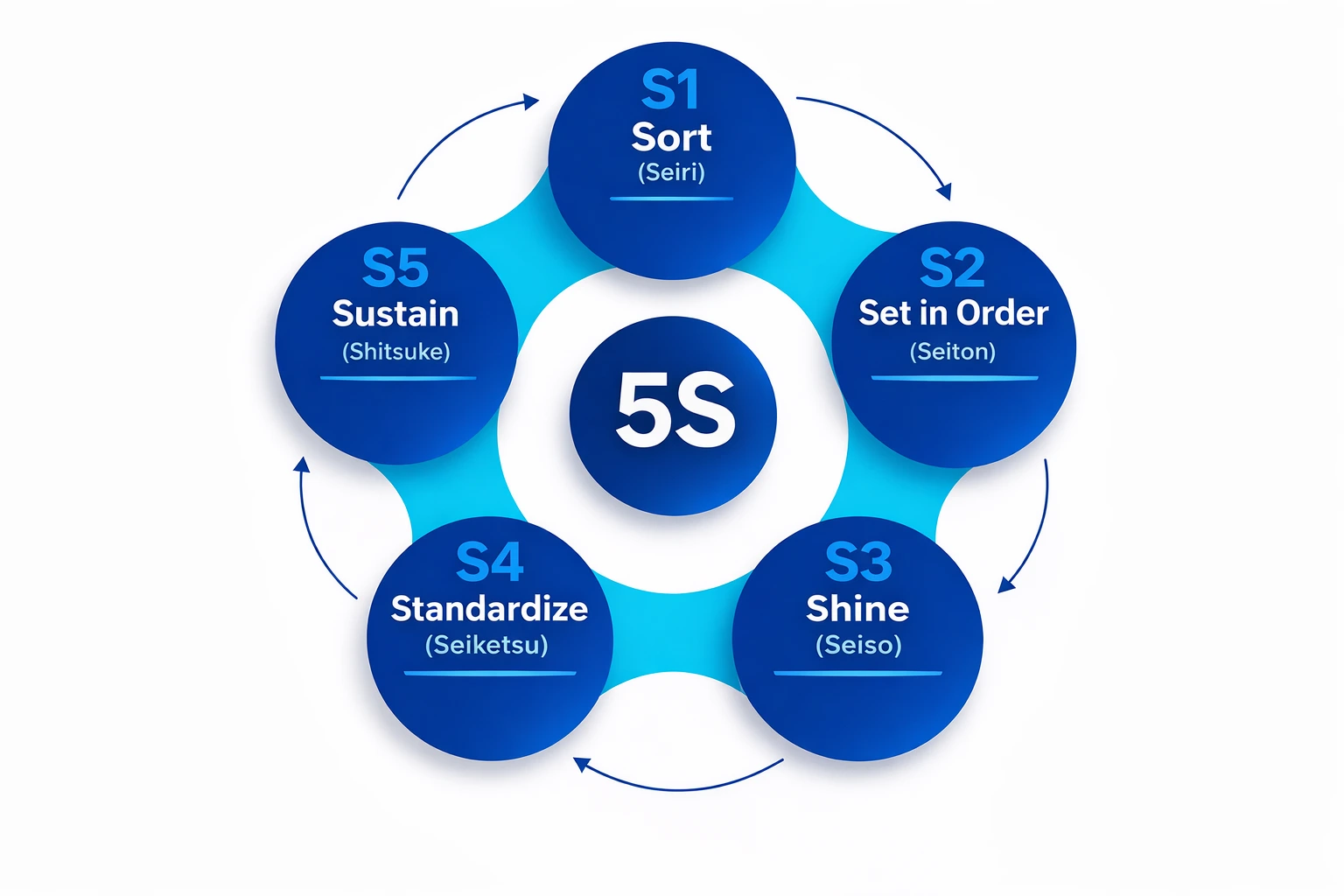
The 5S method is a quality management tool created in Japan and used in many organizations worldwide, especially in the manufacturing industry. The name “5S” comes from Japanese words that describe the five steps of this method:
Seiri (Sort): The first step is identifying and eliminating unnecessary items and materials from the workplace. The goal is to keep only what is essential for the job.
Seiton (Set in order): This step involves establishing fixed places for the remaining necessary items. The goal is to organize the workplace so that needed items can be easily found without wasting time.
Seiso (Shine): In this stage, the focus is on maintaining cleanliness and order. This means regular cleaning and keeping all areas in the best possible condition.
Seiketsu (Standardize): Here, standards and procedures are introduced to help maintain the achieved order and cleanliness. This makes it easier for employees to follow 5S daily.
Shitsuke (Sustain / Self-discipline): The last step is maintaining and continuously improving the implemented changes. Introducing 5S aims to create a work culture that promotes care for order, cleanliness, and organizational effectiveness.
Not using MES system yet? Learn why it’s worth implementing in your company and how to do it. See our resources:
Lean Management is a business strategy and philosophy focused on eliminating waste and optimizing processes to achieve greater operational efficiency while delivering maximum value to the customer.
One of the basic techniques of this approach is the 5S method, which helps effectively implement the most important principles of lean management. 5S helps organize the workplace in a way that minimizes time wasted due to disorder, lack of access to tools, or the need to search for materials, which translates into increased efficiency.
Eliminating waste—avoiding activities that do not add value for the customer—is also crucial in Lean and is made possible with 5S by avoiding excess inventory, unnecessary movements, and waiting for materials.
A clean and organized workplace facilitates quality control and prevents mistakes resulting from chaos. It is easier to identify errors, damages, or quality issues, ensuring better products for the customer.
The 5S method in Lean Management is one of the fundamental techniques, often used as the starting point for implementing lean management. It can be successfully applied in various types of organizations, not only in manufacturing but also in services and other fields.
The 5S principle and the MES (Manufacturing Execution System) are two different tools used in manufacturing production management, but they can be linked in the context of efficiency and process optimization.
The 5S helps improve work efficiency, reduce waste, and create a safer work environment. The MES system is used to monitor, manage, and control production processes in real time.
Their common ground is the pursuit of production process optimization. For example, MES can monitor production performance and gather data on raw material consumption, while 5S on the production line minimizes time losses related to disorder and inefficient layout of tools.
Cooperation between MES and 5S on the production floor leads to more efficient production, improved product quality, and reduced operational costs.
Implementing the 5S method in a manufacturing company can significantly improve workplace organization, production efficiency, and product quality. Here are the step-by-step actions to take:
1. Understand the method and organize a team – Before starting, select employees responsible for specific actions and ensure management understands and supports the benefits.
2. Seiri – identify unnecessary items: Audit workplaces and remove or store away items not needed for production.
3. Seiton – assign specific places to items: Organize the workplace so necessary items are easily accessible and clearly marked.
4. Seiso – prepare a cleaning schedule: Conduct regular workplace reviews and organize a cleanliness schedule that everyone follows.
5. Seiketsu – create standards: Develop work standards and rules for maintaining ergonomics and order, tailored to specific workstations.
6. Shitsuke – monitor and evaluate: Create a monitoring system to ensure standards are met, and conduct 5S training for employees as needed.
7. Improve and measure results: Encourage employees to suggest improvements. Regularly review standards and track performance indicators like efficiency, quality, and safety.
Improved efficiency – 5S identifies and eliminates unnecessary elements, increasing workflow and operational efficiency.
Increased safety – Organizing and labeling work areas minimizes the risk of accidents and injuries.
Improved quality – An organized workspace makes it easier to avoid mistakes and defects.
Time savings – The Seiton stage ensures tools are stored logically, reducing search time.
Increased employee satisfaction – A clean workplace improves employee well-being and motivation.
Easier implementation of other methods – 5S provides a solid foundation for Lean Manufacturing or Six Sigma.
Cost reduction – Eliminating waste and improving quality helps reduce the company’s operational costs.
5S is a workplace organization and management method aimed at improving efficiency, safety, quality, and overall productivity.
Success requires team engagement and long-term discipline. When effectively implemented and maintained, it leads to long-lasting benefits such as higher productivity, lower raw material consumption, and less waste.
Want to learn more? Visit our Knowledge Base, where you'll find articles and webinars by experts to expand your knowledge.