
Digital Technologies and Strategies for Increasing Energy Efficiency
We live in an era of spectacular changes — Technological, Economic, and Business-related. Changes we can prepare for, and those that surprise us day by day.

In today’s dynamic world, where competition in every industry is increasingly fierce, the efficiency and optimization of production processes have become key factors determining a company’s success. The furniture industry is no exception, with its specificity encompassing a wide range of products – from simple tables to complex furniture systems. Quality, timeliness, and product diversity are the aspects that play the greatest role here. In this context, production management in the furniture industry with the help of an advanced tool such as an MES system, becomes not only a beneficial move but an indispensable element capable of providing a competitive advantage.
Production management in the furniture industry is not easy. During planning, you need to consider the availability of raw materials, seasonal changes in demand, and individual customer orders. Optimal use of MES in a furniture company enables the creation of a precise plan that takes each of these aspects into account. This allows manufacturers to avoid wasting valuable resources by ensuring exactly the quantity of furniture that the market currently needs. Optimizing the production plan translates into shorter order fulfillment times and efficient use of machines and workers.
During furniture production, many processes can be susceptible to delays or human errors that are difficult to detect at an early stage. By monitoring these processes in real time, the MES system allows continuous tracking of production progress, responding to potential problems, and adjusting plans in real time. This enables quick intervention and minimizes the risk of unwanted downtime or shortcomings.
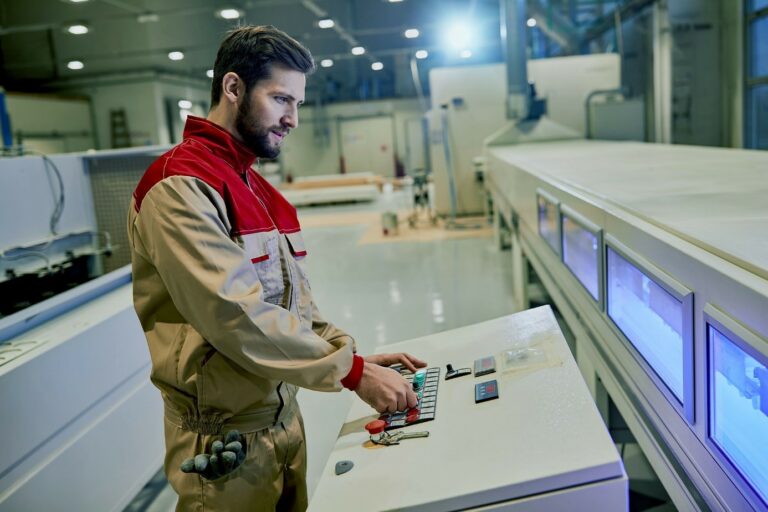
Additionally, MES in the furniture industry allows for the detection of potential defects and imperfections at the manufacturing stage, rather than only during the quality control phase before shipping. This, in turn, reduces the number of defective furniture pieces, increases customer satisfaction, and protects the brand’s reputation.
It can therefore be said that the role of the MES system in optimizing production processes in the furniture industry is crucial. Precise planning, real-time monitoring, and quality improvement are the most important aspects that allow furniture manufacturers to effectively compete in the market, meeting changing customer requirements and efficiently utilizing resources.
Optimal use of MES in a furniture company can bring significantly more benefits than just those mentioned in the previous section. What else can you gain?
Why reliable data is so important and how an MES system can help in collecting it, you can read in this article
Automation in the context of the MES system in the furniture industry means using advanced technologies, such as industrial robotics or internal transport systems, to carry out production tasks. This can apply to both individual production lines and the management of an entire factory. The introduction of robots into furniture production can significantly increase the efficiency and repeatability of processes – for example, they can be used for precise cutting and processing of materials, assembling furniture components, or even painting.
In the context of automation, the MES system in the furniture industry plays a significant role. Above all, it enables the integration and coordination of work between robots and other elements of the production line, and it collects data that allows for accurate tracking of each robot’s progress and identification of potential problems or delays. As a result, quick intervention and real-time process adjustment are possible, which minimizes the risk of downtime and ensures production continuity.

Automation combined with the MES system can also improve work ergonomics and employee safety. Heavy and monotonous tasks can be taken over by machines, while employees can focus on more valuable and creative tasks.
One of the important aspects of introducing automation in combination with MES in the furniture industry is also product personalization. The system enables the collection of data on customer preferences and individual orders. This means that furniture production can be tailored to the unique requirements of each customer, and process automation allows for quick adaptation of the production line to produce small series or even individual pieces of furniture, which increases flexibility and opens the door to new business opportunities.
The application of MES systems in the furniture industry is an investment in the future that can bring long-lasting benefits, improving the efficiency, quality, and flexibility of production processes. Thanks to planning optimization, real-time monitoring, and automation, furniture companies can better compete in the market in the new reality of Industry 4.0, embarking on a path of new development opportunities and success.
Want to learn more? Visit our Knowledge Base, where you'll find articles and webinars by experts to expand your knowledge.