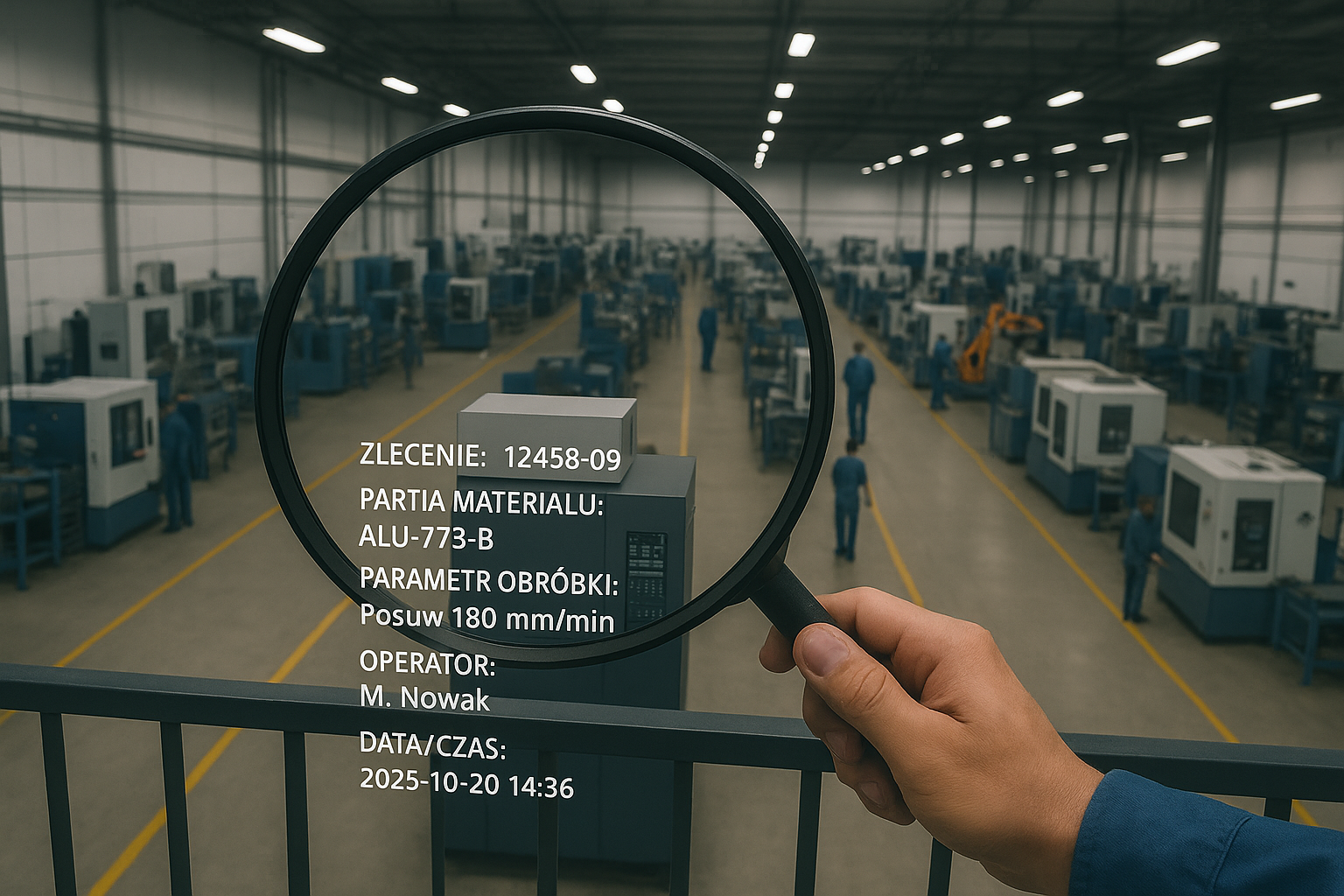
Growing quality requirements, increasingly stringent legal regulations, and customer expectations regarding production transparency mean that traceability is becoming one of the pillars of modern production management. Despite this, many misconceptions still surround it. Companies often invest in it while only partially implementing the idea of product traceability.
In the previous article, we looked at the definitions, types, and areas of traceability. This time, to better understand the topic, we will address the most common myths and misunderstandings related to product traceability. We will clarify which systems support traceability and explain why its role goes far beyond simply ensuring regulatory compliance.
What Traceability Is NOT – The Most Common Misconceptions
In practice, the concept of traceability is often confused with solutions that only partially address the need for process transparency.
Monitoring – traceability is often confused with production efficiency and order monitoring. This provides real-time data on production status, which is extremely valuable, but it is not yet traceability, because this information is not linked to a specific product. Monitoring answers the question “what is happening,” while traceability tells us “how what is happening relates to the product and its history.”
Tracking – another concept wrongly equated with traceability is tracking. It focuses on the current monitoring of a product’s location – for example, the location of a pallet with a semi-finished product. This is important information, but it still does not provide full knowledge. Traceability is not about knowing “where something is.” It primarily covers information about how a given product was made, what it was made from, and under what conditions the manufacturing process took place. Location can be useful in determining those conditions or the environment in which it was located, but it is insufficient.
Traceability in MES-Class Systems
In addition to ERP, there are many other systems that provide valuable data about production and the product, and can thus support traceability. For example, WMS is useful in the warehousing area, LIMS enables the linking of laboratory data with the product, and SCADA monitors processes (but usually does not link them directly to the product). These are, however, only individual aspects related to the issue of product traceability.
The natural place to build full traceability is the MES (Manufacturing Execution System). It integrates data from machines, operators, and quality systems, enabling detailed identification of both the product and the process at every stage.
Why Is Traceability So Important?
First and foremost, traceability contributes to improving product safety and quality. It minimizes risk and enables rapid response if, for example, the need arises to recall defective batches from the market. Moreover, it also helps analyze the causes of problems to prevent them in the future.
Traceability is also a means of ensuring regulatory compliance. In many industries, traceability is a legal requirement – for example, ISO 9001 (the international standard defining requirements for a Quality Management System), GMP (Good Manufacturing Practices) requirements in pharmaceutical and medical production, compliance with IATF 16949 standards in the automotive industry, EUDR for manufacturers using wood in their products, or the American standard FDA CFR 21 Part 11 used mainly in pharmaceuticals. In addition, customers value the transparency and responsibility of manufacturers. Open and transparent production therefore builds trust among customers and business partners, and enables the creation of a strong, trustworthy brand.
As can be seen, traceability is much more than simple tracking or monitoring. It is a comprehensive product and process traceability system that plays a significant role in modern industry.